

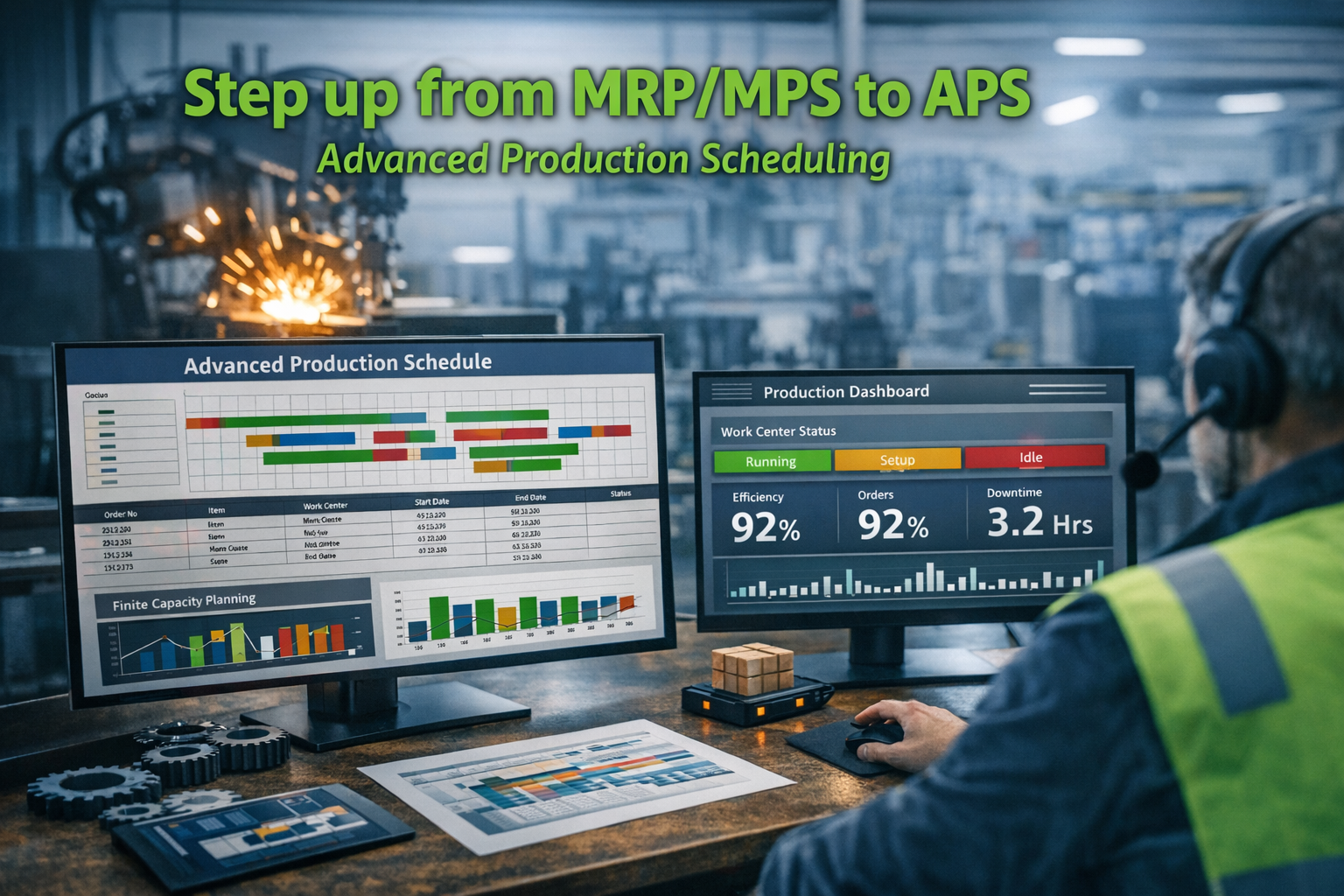
Production planning often looks great on paper, until real‑world capacity, constraints, and sequencing expose the gap between plans and execution.
Production planning often looks great on paper — until it hits the factory floor.
Many manufacturers using Microsoft Dynamics 365 Business Central rely on MRP (Material Requirements Planning) and MPS (Master Production Scheduling) to plan demand, materials, and production orders. While these tools are essential, they also come with a critical limitation: they assume infinite capacity.
That assumption is where planning breaks down.
The Reality of MRP and MPS in Business Central
MRP and MPS are excellent at answering key questions like:
- What needs to be produced?
- What materials are required?
- When should production and purchasing start?
But standard MRP and MPS logic does not account for real-world constraints such as:
- Machine availability
- Labour capacity
- Work centre overloads
- Competing production priorities
The result?
Production schedules that look achievable in the system — but are impossible to execute on the shop floor. This often leaves planners, purchasers, and production teams constantly firefighting, manually adjusting dates, and managing frustration across departments.
Why Infinite Capacity Scheduling Causes Problems
Because Business Central’s native planning assumes unlimited capacity, it can generate:
- Overlapping production orders on the same machine
- Purchase orders with unrealistic delivery dates
- Promises to customers that operations simply cannot meet
Planners are forced to compensate with spreadsheets, manual sequencing, and experience-based decision-making. Over time, this erodes confidence in the planning system itself.
Moving from Planning to Execution with APS
This is where Advanced Production Scheduling (APS) comes in.
APS builds on the MRP/MPS foundation but introduces finite capacity scheduling. Instead of assuming unlimited resources, APS evaluates:
- Available machines and work centres
- Labour and shift calendars
- Routing sequences and dependencies
- Material availability and lead times
The outcome is a realistic, achievable production schedule that reflects how your business actually operates.
What APS Changes in Practice
When APS is introduced into Business Central, planners gain the ability to:
- Create production schedules that respect real capacity constraints
- Eliminate overlapping or impossible production orders
- Sequence work intelligently across machines and shifts
- Align purchasing dates with what production can actually execute
Instead of constantly rescheduling, teams can focus on proactive planning and continuous improvement.
A Better Experience for Planners and Purchasers
APS doesn’t just improve schedules — it makes planners’ and purchasers’ jobs achievable again. With APS:
- Purchase orders are generated with realistic receipt dates
- Production plans reflect what can actually be completed
- Teams spend less time “fixing” the plan and more time executing it
This creates confidence across production, procurement, and customer-facing teams.
Why This Matters for Growing Manufacturers
As manufacturers grow, production becomes more complex:
- More SKUs
- More machines
- More dependencies
- Tighter customer delivery expectations
At that point, relying solely on infinite-capacity MRP and MPS becomes a bottleneck. APS allows businesses to scale without losing control of delivery performance or operational efficiency.
How ERP365 Helps
At ERP365, we help manufacturers take the next step beyond basic planning by extending Microsoft Dynamics 365 Business Central with practical APS capabilities.
We work with you to:
- Identify where MRP/MPS is breaking down
- Introduce finite-capacity scheduling aligned to your operations
- Configure APS solutions that fit your production reality — not a theoretical model
The goal isn’t just better plans. It’s plans that work on the shop floor.
Want to See APS in Action?
Watch the full video:
Business Central: Step up from MRP/MPS to APS Advanced Production Scheduling
here
Or get in touch with us to discuss how APS can transform production planning in your business. 📍